

Civilisation's Nervous System, Built From Thin Air
Part 1 - How Wireless Infrastructure Became Critical Infrastructure


“Do you think that's air you're breathing?”
Morpheus
When I was eight years old, my dad brought home a little book one day. It was called Making a Transistor Radio and it was published by a company called Ladybird.
I didn't know it at the time but it was probably one of the most important books I ever owned.
That was 1972, and back then when electronics hobbyists talked about breadboarding a prototype, they actually meant getting a plank of wood that you might use to cut some bread on, and fastening electronic components down onto that plank using brass screws. Components were big back then. We didn’t need to work with Quad Flat Pack or Ball Grid Array devices. We didn’t in fact have anything much that was a surface mount device. Everything came with wires or pins attached, neatly spaced out on a 1/10th of an inch grid.
So for the first week or two I was learning how in the name of heck a clumsy eight year old was supposed to screw those screws into that stupid plank of wood…a skill that had very little to do with electronics but did involve plenty of splinters.
Then my dad brought home this big bag of things that looked like sweets - funny little blobs of plastic stuff with multi coloured stripes painted down the sides.
Great! Now I had to work out how to trap those fiddly little wires underneath those annoying little screws of my increasingly mangled breadboard with fingers numb and wrapped in Band-Aids.
The first part of that classic Ladybird book described how to build a crystal radio, which - for those unfamiliar with such antique technology - is a totally passive receiver able to pick up AM radio signals, most of which seemed to come from obscure European stations in languages I could not understand. I listened through a little earphone jammed into the side of my head, while hunched over the splinter-laden plank with its jumble of precarious wires and components. Mostly I would hear whistles and pops and bleeps in my ear, and wonder where on earth those sounds might be coming from. Once or twice I accidentally stumbled across Radio Caroline...
That, dear reader, was (and to some extent still is) radio.
Over many subsequent years spent designing systems for defence and security applications I came to understand a lot more about what this medium actually is. Floating all around us, and often straight through us, radio frequency signals - electromagnetic waves - some natural, some from outer space, and today in our cities mostly man-made. To most of us they remain unseen, unheard and mostly unnoticed, but increasingly we cannot do without them.
What’s So Rad About Radio?
Like so many other misunderstood phenomena, RF exists on a spectrum.
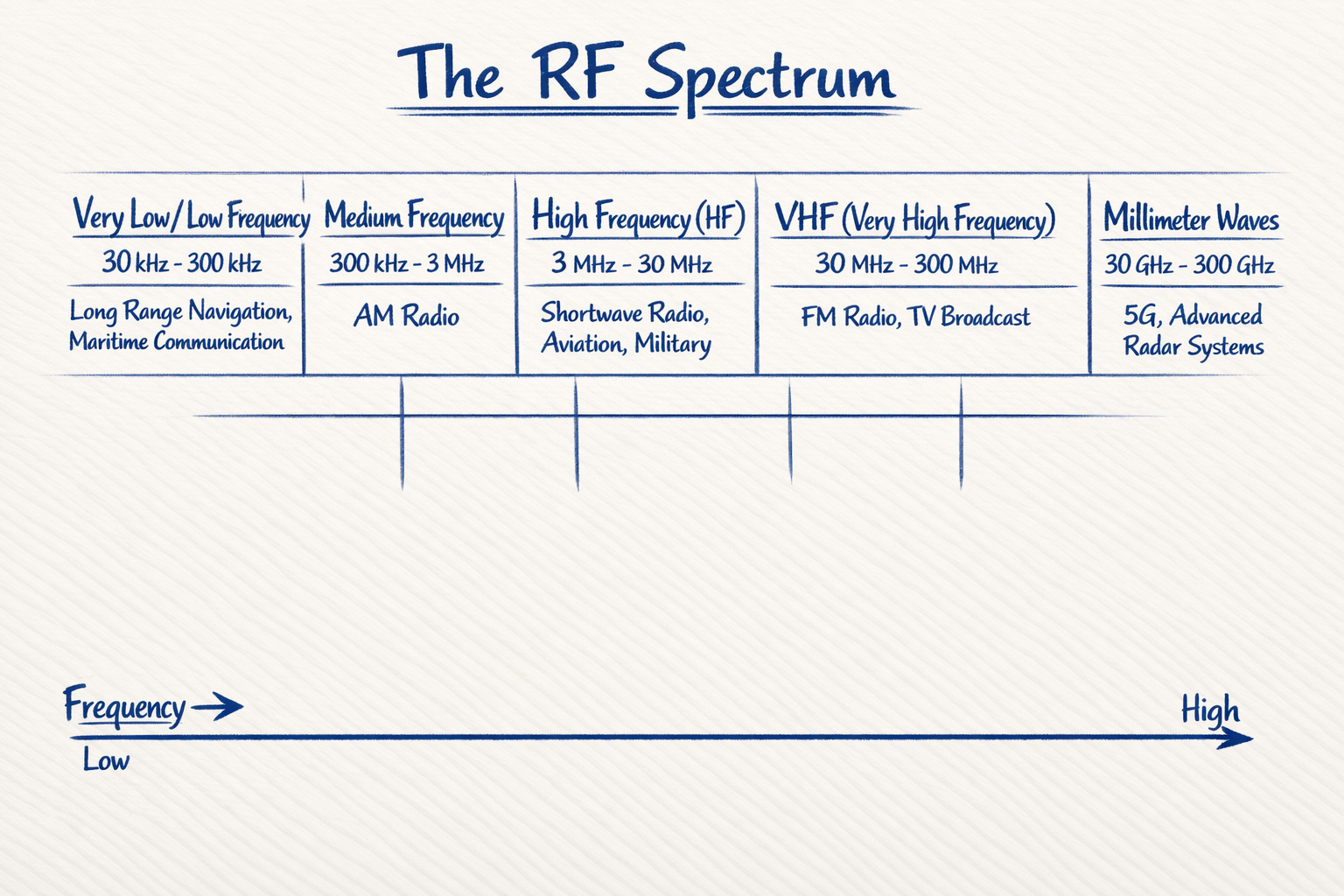
We have a number of different ways to characterize the signals themselves. Sometimes we talk about their wavelength, but we also describe them in terms of their frequency, which defines the number of cycles of that wave occurring in a one second time frame. The unit of frequency is the Hertz (Hz), but in the RF world we’re generally talking about very high frequencies, so you’re going to hear people talk more about Kilo-Hertz (thousands of cycles per second - kHz), Mega-Hertz (millions of cycles per second - MHz) or Giga-Hertz (billions of cycles per second - GHz).
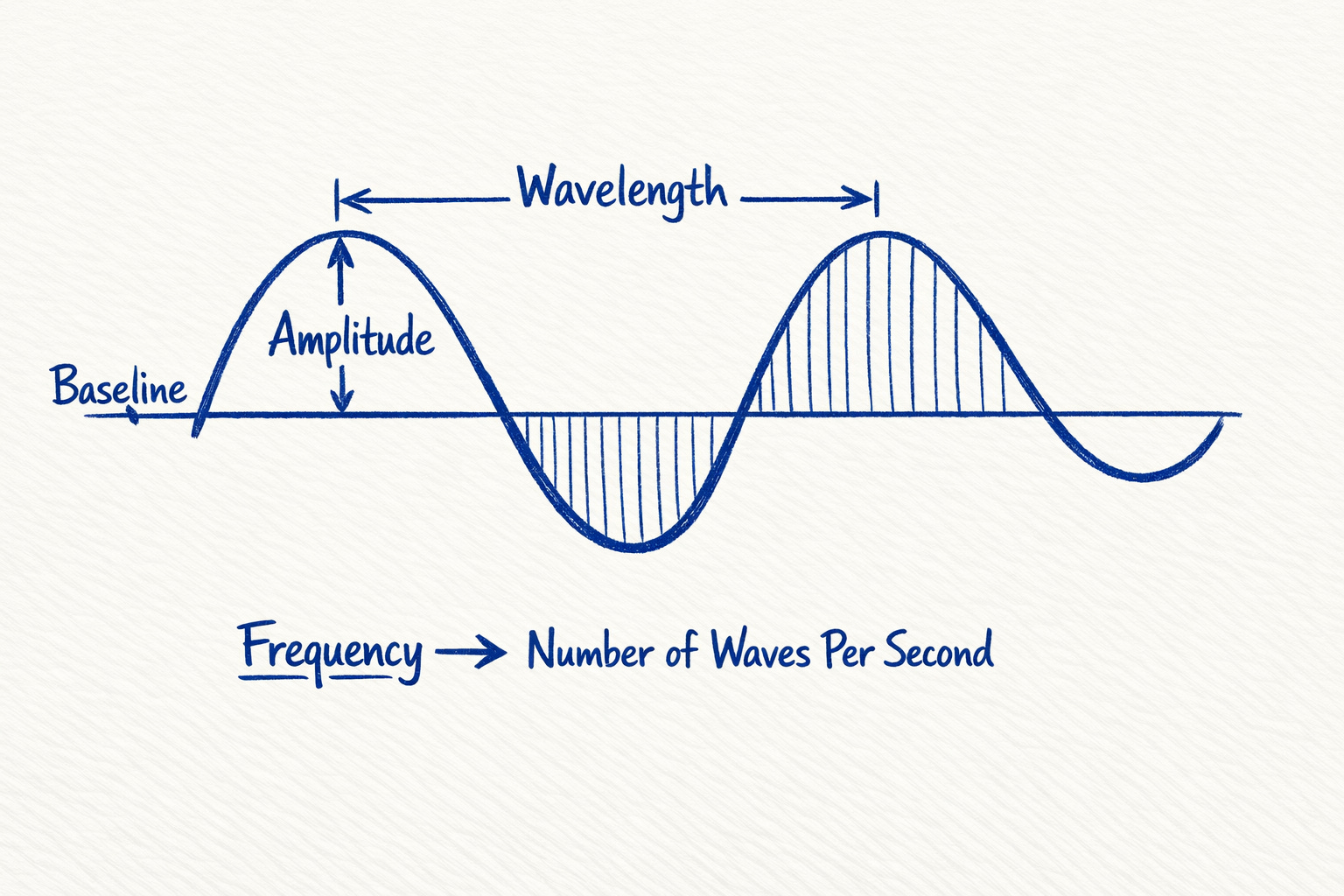
RF signals down at extremely low frequencies are not very useful. It’s not that they don’t exist, but handling them is unwieldy because of the way aerials work (or antenna, as they’re often referred to by RF people) , and their inability to be encoded with very much useful data. However, they have some useful features - such as their ability to penetrate water…handy for communicating with secretly secluded submarines, among other things.
Much of the remainder of the practically available RF spectrum is very heavily used by we humans, and in fact, spectrum overcrowding is a very serious issue in some of its most useful frequency bands. Each frequency in the spectrum is a bit like a room in a building. If you have one person in there talking and another listening, then all is fine. Throw a rave in one of those rooms and you’re going to lose the gist of the conversation and maybe annoy the landlord…
Not To Infinity or Beyond
One of the things that often reveals the lines between science and technology, is where somebody comes along with a really great product that relies on some technological principles that were developed from a sub-set of the science. In the electronics space this started to become an issue when processor clock speeds began increasing from the MegaHertz to the GigaHertz range. Electronic components, the circuit boards and the wires connecting them together began behaving more like radio transmitters and receivers than plain old bits of circuitry.
Those behaviors are well understood, science-backed principles that help us build all manner of complex wire-free communications systems today, systems that we can use to talk to each other around the world, or keep in touch with Artemis-II - except when it’s on the opposite side of the moon - but as the frequencies get higher and higher, more and more troublesome effects come in to play (not least the line-of-sight issue that kept us biting our fingernails while those astronauts traversed the Dark Side of the Moon), meaning that we simply cannot expand ever-upwards across the RF range, no matter how much our understanding of the science behind how it works might evolve.
Instead, we need to cram all of our wireless systems into sections of the spectrum to which they are suited, depending upon whether we need long range, high data capacity, high coherence, minimum interference, or whatever else, and build systems with which to make sure this valuable space does not become a battleground for potential users to fight over.
Just the same way that we adopted standard interfaces and protocols in networking so that everyone can connect with everyone else, wireless communications has shaken down into one group of commoditized open standards (i.e. WiFi, Bluetooth, 4G, 5G, GSM etc) and another group of not so open stuff elsewhere that’s either very unusable or very heavily licensed.
…and Not Just For Social Media
But RF is not just about communications.
Radar, telemetry, sensing. RF is all over the place. And it's natural too. Radio frequency signals from our ionosphere, from lightning and from the earth itself form part of what we would see if we could see parts of the electromagnetic spectrum other than light, and the signals from outside of our planet come from all manner of sources all the way back to the Big Bang.
EMI from all sorts of electrical and electronic devices represent a significant chunk of the background noise across the whole of the frequency spectrum all the time all over the place. Grab yourself an oscilloscope, wave a probe in the air and wherever you are in the world you will see a lovely background signal at either 50Hz or 60Hz depending on what the mains power frequency is in your neighborhood.
In fact, the amount of harvestable RF energy in the air is so significant that there are IoT devices on the market now that can power themselves from it.
The availability of commodity RF systems such as these - the tippy-toe grabbed 4G for the Insta of your street cafe breakfast in Tokyo, or the one-bar-WiFi pizza order from the basement of your Bahrain datacenter - are what have made the Internet of Things a possibility, rather than a pipe dream where there is no pipe. If the critical infrastructure your devices need to be useful is available everywhere and everywhen in a low-cost format, then it’s easy to see why everyone might want to jump on that bandwagon instead of having to build it all from scratch.
The increasingly universal ubiquity of WiFi and 4G/5G, and the costlessness of things like Bluetooth for tethering short range devices into the network have delivered entire industries into the world. With well over half of global data center workload already consumed by mobile related traffic, and the vast majority of internet access coming from wirelessly connected devices (laptops, phones, home appliances, headphones, gym equipment, games, point of sales, taxi services, cleaning robots, drones and just about everything else you can think of), the level of dependency on the relatively narrow range of services that make it all possible should be raising more red flags.
We have built civilisation’s nervous system out of thin air.
The same characteristics that make commodity RF cheap, ubiquitous, and transformative are precisely what make it exploitable. And the organisations that depend on it most have almost no awareness of what’s happening in the spectrum they inhabit
In the next part of this short series on RF I am going to talk some more about some of the specific security risks we are currently facing from the use and abuse of the spectrum. Hold on to your Fitbits everyone…your blood pressure may be on the up!
Subscribe to receive the next installments of this short series on Radio Frequency and the growing importance of taking it more seriously.